
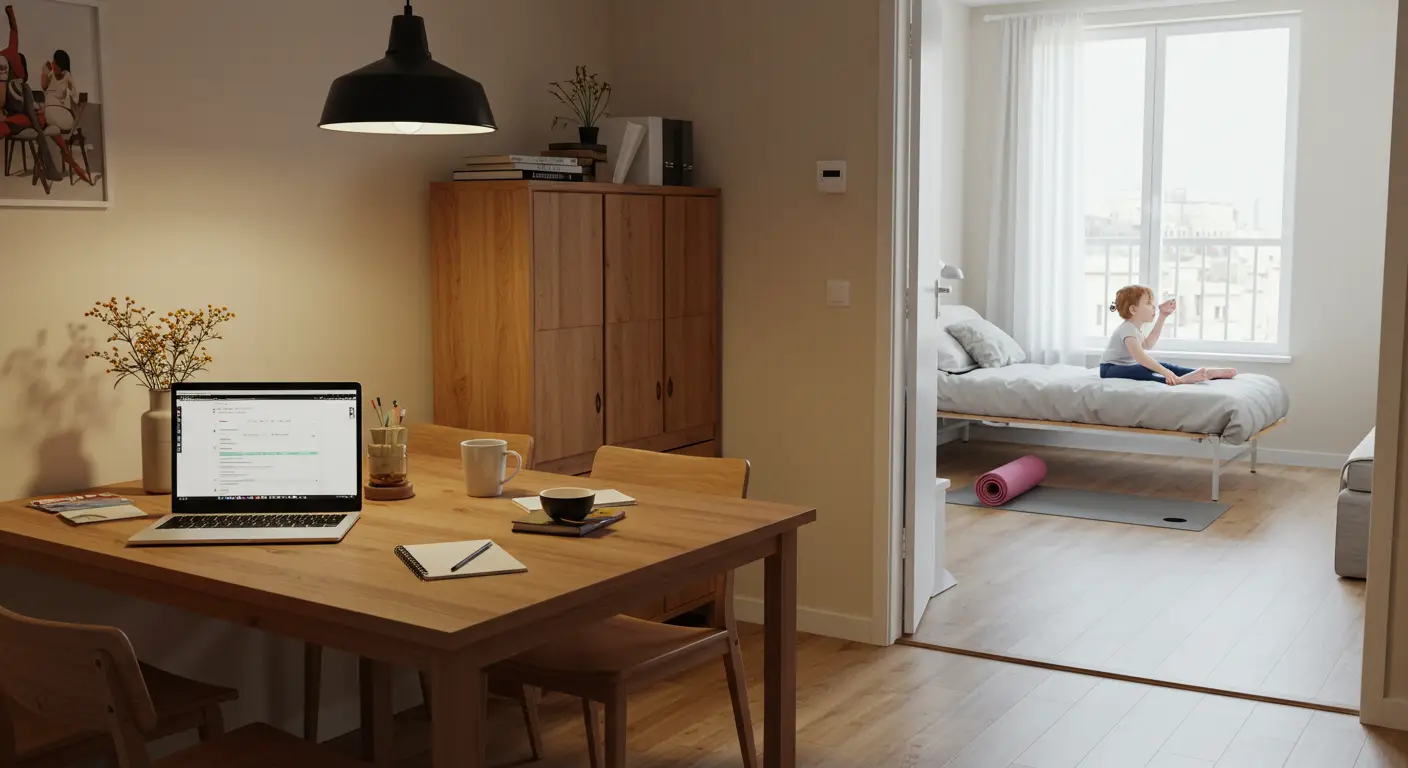
The Dining Table That Became Everything
In early 2020, Patricia’s dining table suddenly earned a promotion. By day it was her office, by evening it doubled as a homework desk for her grandchildren, and at night it reverted to its original purpose — a place to eat. The spare room became a yoga studio. The kitchen counter was briefly a printer station.
What started as a makeshift survival plan hardened into habit. Three years later, Patricia still works at her dining table a few days a week and still rolls out her yoga mat in the “guest room.” What once felt like compromise is now her normal.
Her story is hardly unique. The pandemic didn’t invent multifunctional living, but it catapulted it into the mainstream. Homes were suddenly forced to become everything, everywhere, all at once.
The Psychology of Hybrid Homes
Environmental psychology has been busy trying to catch up with this new reality. While the research is young, some consistent threads are emerging:
- Boundaries matter. Adults who carved out even symbolic separations — a corner desk, a different chair for “work mode” — reported lower stress than those who blurred it all together.
- Clutter weighs heavily. Storage investments skyrocketed during lockdown, and not just for aesthetic reasons. Psychologists have long noted the cortisol-clutter link: messy environments quietly elevate stress.
- Light and ergonomics shape cognition. Studies of remote workers found natural light and decent setups improved focus and energy. The exact arrangement varied, but the principle held: comfort fuels performance.
Of course, context rules. A loft in Newtown has different possibilities than a villa on the Central Coast. But the theme is clear: people thrive when spaces can flex without feeling chaotic.
Why It Matters Now
If the old family house was sprawling enough to hide a bad decision (that rarely-used gym room, the formal dining gathering dust), smaller homes are less forgiving. Every square metre has to earn its keep.
Think about how needs might shift:
- Quiet daily life most of the time, punctuated by visiting family.
- A study nook that doubles as a guest space.
- A living room that can handle Netflix on Tuesday and twelve people on Saturday.
- Storage that hides the mess before you have to see it, let alone your guests.
This isn’t about predicting every possible scenario. It’s about choosing bones that can bend.
Inspection Day Checklist
Next time you’re touring a property, don’t just ask “where would the sofa go?” Ask:
- Can furniture be rearranged without the whole place feeling cramped?
- Does natural light reach more than one zone, or is there a single “good” corner?
- Is there accessible storage that allows quick changeovers (yoga mat away, laptop out)?
- Are power points and internet connections spread where they’ll actually be useful?
- Could two people do two completely different activities without driving each other mad?
These questions cut through glossy brochures and reveal how a home really functions.
The Long-Term Payoff
Flexible homes are less about gimmicks and more about psychology: the reassurance of knowing that as life shifts, your space can shift too. That sense of control is quietly powerful — especially during times of transition.
Well-planned multifunctionality also supports social wellbeing. A living area that hosts a quiet morning coffee can, with a few tweaks, welcome a dinner party. A guest room that moonlights as an office doesn’t feel like wasted space. Adaptability becomes its own form of sustainability.
Closing Thought
The pandemic simply accelerated a truth we were edging towards anyway: homes are no longer just backdrops, they are stages for every part of life. Work, rest, play, stretch, Zoom, celebrate — all within the same walls.
The best properties aren’t the ones frozen in time, but the ones with enough give to let you rewrite the script as needed. Hybrid homes aren’t the future; they’re the present. The real question is whether the next space you choose will support who you are now — and who you might become next.